
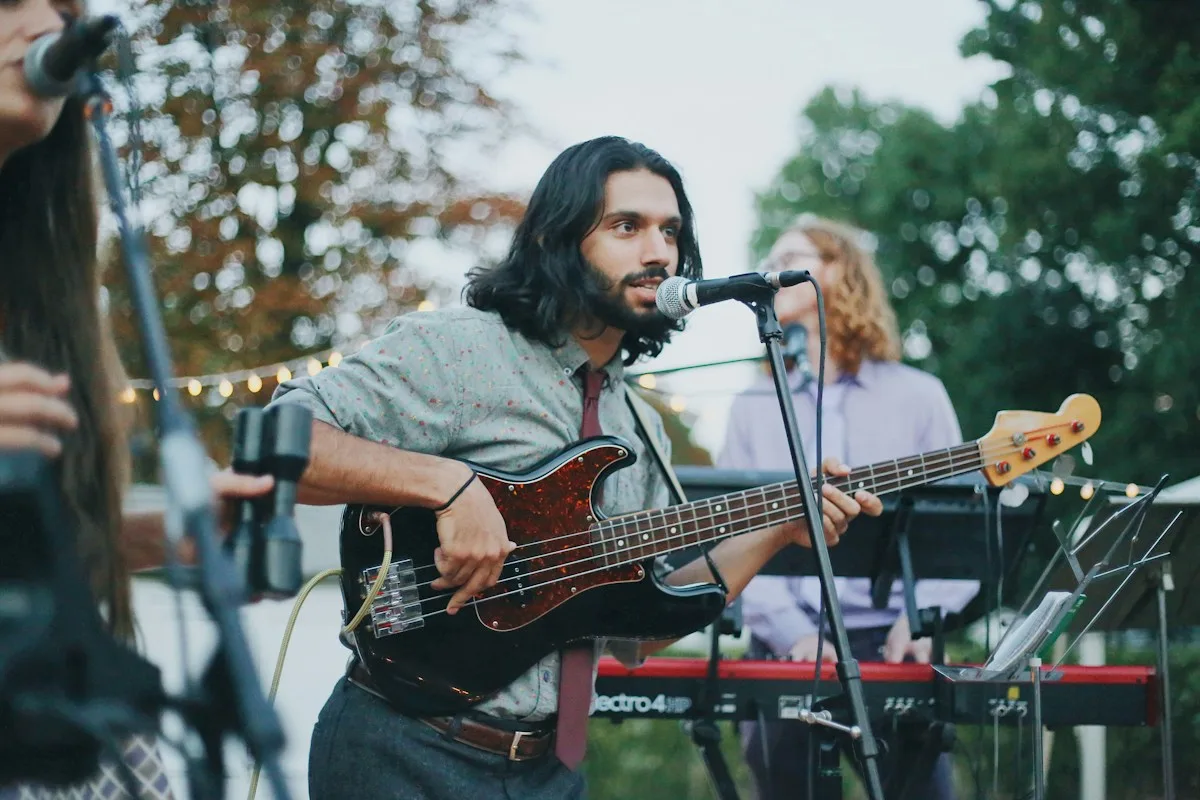

Music runs through almost every part of a wedding, from the first guests taking their seats to the last song of the night. It’s much easier to choose when you treat it as a series of moments, each with its own job, rather than one long playlist.
This guide walks through each moment and what its music needs to do. It also shows how to check that a love song really is one, and links to our artist guides if you already know whose music you want.
| Moment | What the music should do | How many songs |
|---|---|---|
| Prelude, as guests arrive | Fill the room quietly while people find their seats | A short playlist |
| Processional | Set a steady, unhurried pace for the walk down the aisle | 1 to 3 |
| Signing or unity ritual | Cover a few quiet minutes without stealing focus | 1 or 2 |
| Recessional | Mark your first walk as a married couple | 1 |
| Cocktail hour and dinner | Stay in the background so guests can talk | A long playlist |
| Grand entrance | Set the tone for the party | 1 |
| First dance | Say something about the two of you | 1 |
| Parent dances | Feel warm and personal | 1 each |
| Cake cutting | Keep it light | 1 |
| Dance floor | Get the most guests moving | Most of the evening |
| Last dance or send-off | Give the night a clear ending | 1 |
Ceremony music
Prelude
The prelude plays while guests arrive and find their seats, so it should be pleasant without demanding attention. Instrumental pieces, acoustic covers and soft jazz all work. Joy’s ceremony music guide suggests six to ten songs.
Processional
You can use one song for the wedding party and a second for your own entrance. The same Joy guide recommends a tempo under about 80 beats per minute for a composed walk. If a song you love has lyrics that distract from the moment, look for an instrumental or string version. Tell your musicians or DJ when to fade out, and walk it once at the rehearsal so the timing feels natural.
Signing or unity ritual
Signing the register, lighting a candle or any other ritual leaves a few quiet minutes. One gentle song, or the second half of a longer one, fills the gap without pulling attention away from what’s happening.
Recessional
The recessional is your first walk as a married couple, and the mood can lift straight away. Pick something upbeat that your guests will recognise within a few notes.
Check your venue’s rules first
Some venues, especially religious ones, limit secular or recorded music during the ceremony. Ask what’s allowed before you settle on a song for the aisle.
Reception music
Grand entrance
Your entrance into the reception sets the tone for the party. Choose something with energy that starts fast. A slow build loses the room before the chorus arrives.
First dance
This is the song most guests will remember, so choose one that says something true about the two of you. Read the full lyrics and the story behind the song before you commit (see the next section). If the song runs long, ask your DJ to fade it out when you signal, or invite guests to join you halfway through. Our tips for first dance photos cover the lighting and timing your photographer will need.
Parent dances
Parent dances suit songs about family, gratitude or growing up rather than romance. Ask your parents if there is a song that matters to them. It’s often the easiest choice to make.
Cake cutting
The cake cutting is a short, light moment, so pick something playful and familiar.
Dance floor
The dance floor is where you hand most of the decisions to your DJ or band. Give them a sense of your guests’ ages and tastes, a list of songs you must hear, and a list of songs you never want to hear. Mixing eras keeps every generation dancing at some point in the night. For more ideas on keeping guests entertained, see 8 ways to make your wedding reception merry and memorable.
Last dance and send-off
The last song should feel like an ending. A slow song brings everyone together one last time; an upbeat one sends guests out on a high.
Is it a love song or a breakup song?
Some of the most popular wedding songs aren’t about love at all. A warm melody can hide a story about jealousy, leaving or regret, and guests who know the backstory will notice. Before you choose a song for a meaningful moment, read the full lyrics and look up why it was written. Three well-known examples:
- “Every Breath You Take” by The Police. It is often played at weddings, but Sting described it in 1983 as a song about jealousy, surveillance and ownership (Songfacts; Wikipedia).
- “I Will Always Love You” by Dolly Parton, later a hit for Whitney Houston. Parton wrote it as her goodbye to Porter Wagoner when she left his TV show in 1974 (Dolly Parton’s official site). It’s a farewell song, so it suits a tribute better than a first dance.
- “Dreams” and “Go Your Own Way” by Fleetwood Mac. Both are about the breakup of Stevie Nicks and Lindsey Buckingham. They’re great on the dance floor, but not for a first dance.
Wedding songs by artist
If you already know whose music you want, these guides sort each artist’s songs by wedding moment and explain the story behind each one:
- Fleetwood Mac and Stevie Nicks wedding songs: 12 picks for every moment
- 17 Counting Crows songs for your wedding
DJ, live band or both?
Who plays your music matters as much as what they play. A DJ can play the original recording of any song, while a band brings live energy but has a set repertoire and needs time to learn new songs. Our guide to DJ vs live band weighs the trade-offs, and how to pick wedding band musicians covers what to ask before you book. Popular musicians and DJs book up early: Joy suggests booking six to twelve months ahead.
How to build your wedding playlist in seven steps
- Agree on the big moments with your partner first. Start with the processional, first dance and last dance, especially if your tastes differ. Everything else is easier once those three are settled.
- Map every moment. Use the table above and write a song, or a style, next to each one.
- Check every lyric and backstory. Read the full words of each song for a meaningful moment, not just the chorus.
- Feel free to break tradition. You don’t need a classical processional or a slow first dance. A string cover of a pop song, a family favourite or a song in your own language can mean more.
- Plan your exit music. The last song and the send-off are easy to forget, and they’re the last thing guests hear.
- Ask guests for requests, but keep a veto. A line on the RSVP card asking for one song gets guests involved and gives your DJ a sense of the crowd.
- Give your DJ or band a final list. Include each moment’s song, a must-play list and a do-not-play list. Joy suggests 10 to 15 must-plays and 10 to 20 do-not-plays.
For scale, Paperlust estimates that a six-hour wedding day, ceremony included, needs 80 to 100 tracks in total. You only need to choose a handful yourself. Your DJ or band fills the rest from your must-play list and their sense of the room.
When and how music fits into the rest of your planning is covered in our Wedding Planning Guide.