
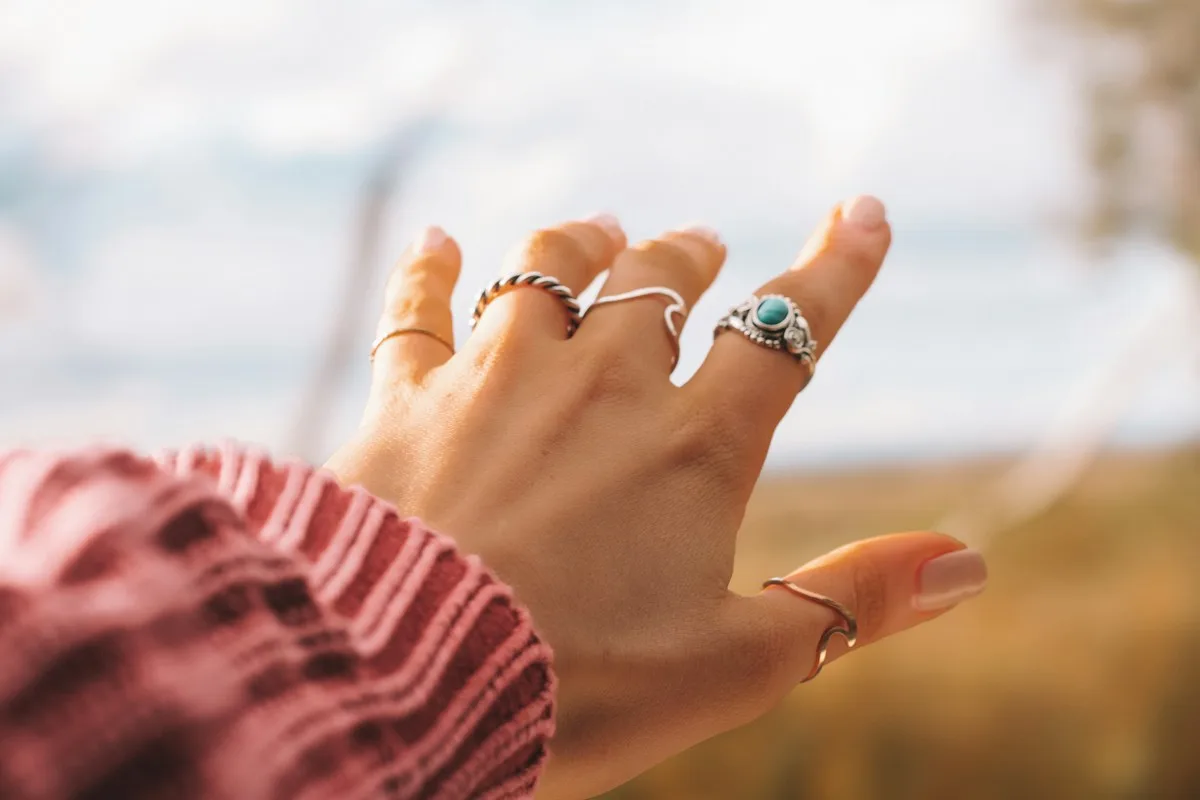

You can wear a ring on any finger you like. Some placements, though, carry real traditions: wedding customs, family signets, even a ring that marks a profession. This guide goes finger by finger through the documented ones, and separates them from the folklore that fills many online charts.
Quick chart: ring meanings by finger
| Finger | Documented traditions | What it usually signals today |
|---|---|---|
| Thumb | Archers wore thumb rings to protect the thumb when drawing a bow | Personal style; a bold statement |
| Index | In Jewish weddings, the ring is placed on the bride’s right index finger | Statement and signet rings |
| Middle | No widely shared tradition | Personal style |
| Ring finger | Engagement and wedding rings, on the left or right hand depending on the country | Commitment |
| Little finger | Family signet rings in Britain; Canada’s Iron Ring for engineers | Heritage, profession or style |
Why the “ring finger” is the ring finger
The fourth finger owes its job to a myth. People once believed a vein, the vena amoris or “vein of love”, ran straight from the fourth finger of the left hand to the heart (Wikipedia). The idea is often credited to the ancient Egyptians, Greeks and Romans, and the custom of wearing the ring on that finger goes back at least a thousand years (Discover Magazine).
Anatomy doesn’t back it up: every finger’s veins return blood to the heart the same way. The tradition stuck anyway. For more of the story, read our history of wedding rings.
Left hand or right hand?
In the US, Canada, the UK and Australia, engagement and wedding rings usually go on the left hand (David’s Bridal). In Russia, Germany, Norway, Austria and India, the wedding ring traditionally goes on the right-hand ring finger (Zola).
Customs vary within countries, and many couples now simply choose. If you’re unsure where yours goes, the custom where you married is a good default. See also engagement rings vs wedding rings and our guide to men’s wedding bands.
Finger by finger
Thumb
The thumb ring’s longest history is practical. Archers who drew the bowstring with the thumb wore a ring to protect it, and decorated versions could also signal rank and status (The Met). Today a thumb ring has no fixed meaning; it’s a confident style choice.
Index finger
In a Jewish wedding ceremony, the groom places the ring on the bride’s right index finger. Many brides move it to the ring finger afterwards (My Jewish Learning). Outside that custom, the index finger is a natural home for statement and signet rings, because it’s the most visible finger when you gesture.
Middle finger
There’s no widely shared tradition for the middle finger. It sits in the centre of the hand and balances a larger ring well, so it’s a good place for a bold piece or an inherited ring that’s too big for your ring finger.
Ring finger
This is the finger for commitment:
- Engagement and wedding rings are usually worn together on the same finger, stacked (The Knot).
- Promise rings usually go on the right-hand ring finger, so they aren’t mistaken for an engagement ring. If you wear one on the left, the tradition is to move it to the right after marriage (The Knot).
Shopping for one? Start with our engagement ring guide.
Little finger (pinky)
Two traditions are well documented:
- Signet rings. In Britain, the little finger of the left hand is considered the traditional place for a family signet ring (Wikipedia). King Charles III wears his there (Lyon & Turnbull).
- The Iron Ring. Canadian engineers receive a ring at a ceremony that began in the 1920s and wear it on the little finger of their working hand, as a reminder of their professional duty (The Canadian Encyclopedia).
Beyond those, a pinky ring is simply a style choice.
The Claddagh ring
The Irish Claddagh ring has its own rules: which hand you wear it on, and which way the heart points, can signal whether you’re single, in a relationship, engaged or married. Our Claddagh ring guide explains each position.
What about palmistry meanings?
Many “ring meaning” charts come from palmistry, which links each finger to a planet: Jupiter for the index, Saturn for the middle, Apollo (the sun) for the ring finger and Mercury for the little finger (Barkev’s). It can be fun to read, but it’s folklore rather than a tradition people will recognise when they see your ring.
How to choose where to wear yours
- Commitment rings: the ring finger of whichever hand is customary for you.
- Signet or heirloom rings: traditionally the little finger of your non-dominant hand. A ring that doesn’t fit there can go on the middle finger.
- Statement rings: the index or middle finger, with one statement piece per hand so they don’t compete.
- Fit first: knuckles and finger shape matter. See men’s vs women’s ring sizes and matching rings to your finger type.